
Asar
August 25, 2025
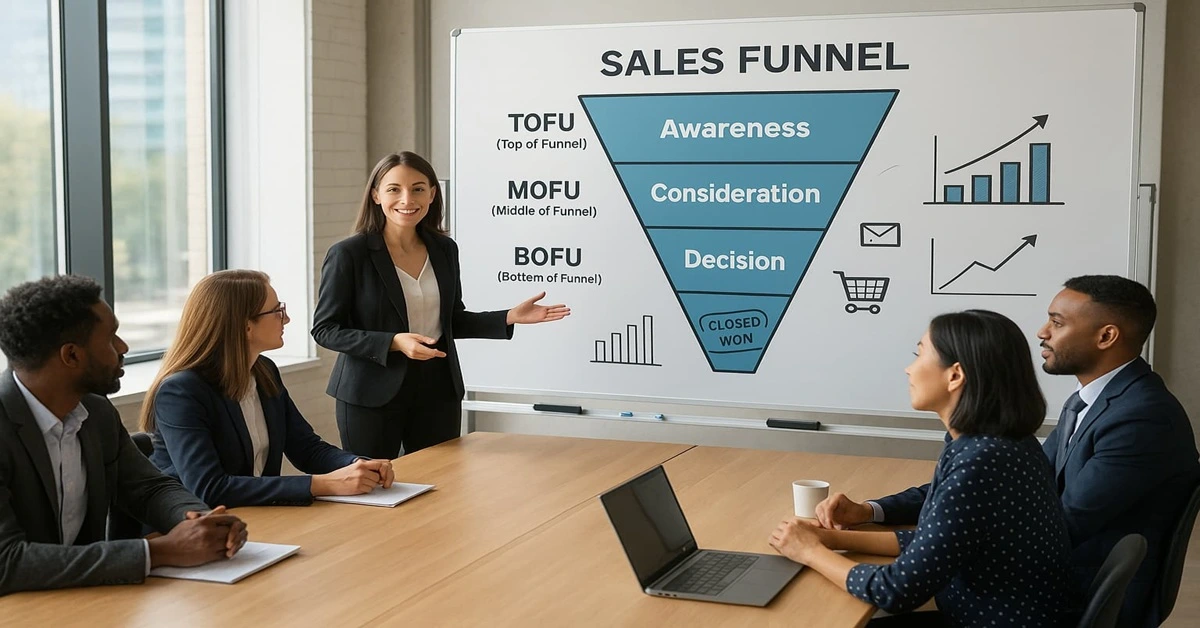
What is a Sales Funnel, you ask? Well, simply put, a sales funnel is just a way of classifying your potential customers based on the level of interest they show in your product or service.
It’s like a roadmap which helps you understand the journey of a prospect from when he sees your or hears your brand to making a purchase or becoming your loyal customer.
As a business owner, you might have felt the need to put your leads into buckets based on which you can tailor your efforts to entice them to buy your product or service, or retain them by upselling them better value.
A well-oiled Sales Funnel gives you:
Now that we know what a Sales Funnel is, and how it can help you achieve your business goals, let’s turn our attention to the “How?”.
You might be worried you’re not “business savvy” and would need to read a lot on how to go about building a funnel on your own. Worry not, we’ve got you covered.
Just read along the next section and see for yourself how easy and relatable a sales funnel is.

Also called “Persona,” an ideal customer is one who is really the target audience of your product or service.
Would your marketing campaign appeal the same to an 18-year-old college kid looking to buy a cool pair of sneakers as it would to a 40-year-old business executive looking for classic Oxfords?
Develop a detailed profile of your customer with factors like:
By now, you have an image of your ideal customer. Now, visualize the ideal path that a prospect takes from becoming aware about your brand to becoming a loyal customer.
A typical customer journey looks like the following:
Based on your customer journey, define the distinct stages
of your sales funnel. A common way to do it includes:
Here are some ways to do it:
2. Middle Of the Funnel (MOFU): This is the Consideration stage of the sales funnel where the goal is to nurture leads by providing valuable information and positioning your brand as an ideal solution. Some ways to do it are as follows:
3. Bottom Of the Funnel (BOFU): This is the stage where you convert qualified leads into paying customers. Some efforts in this stage include:
4. Post-purchase: This is the stage where you should aim to retain customers and encourage them to be your advocates and evangelists. Some efforts to this end include:
Creating valuable content at each stage of the sales funnel ensure your customer gets the right information at the right time. Craft your content for each funnel differently.
When you capture relevant information about your prospect, you can reach out to them more effectively at different stages in the funnel. You can use:
When building a sales funnel, nurturing your leads requires lot of efforts which honestly, isn’t ideal for one man to do it all.
Consider automating some aspects of your customer journey, for example, sending out automated emails about latest offers, or whitepapers published, or even reminders about expiring subscriptions.
According to Marketo, nurtured leads make 47% larger purchases than non-nurtured ones.
Define, implement and monitor specific conversion goals at each stage of your sales funnel.
Here are some key metrics that you can track at different stages in the funnel:
Building a Sales Funnel is an ongoing process. It’s never a “build once, use forever” activity.
It is dynamic because you continuously analyze newer data to identify bottlenecks, underperforming stages and improve conversion rates.
Experiment with different content, tactics, and messaging, and iterate based on the results. A study by Aberdeen Group found that companies that regularly optimize their sales process experience 54% greater year-over-year revenue growth.
It is rarely feasible for anybody to monitor their Sales Funnel on their own.
As you scale up, consider a Customer Relationship Management Tool (CRM) to manage leads, organize contacts, visualize data and consequently areas of improvement.
A CRM is a trustworthy companion that helps you gain valuable insights into your sales process.
A Sales Funnel helps you maintain sustainable growth by helping you understand your customer’s mindset at each stage, providing them with the right set of information at the right time through valuable content and continuously optimizing your marketing efforts based on data and insights.
While it might look like a lot of legwork initially, the long-term benefits of a consistent lead generating machine and converting them into loyal customers are invaluable.
A sales funnel is business-centric, customer journey is customer-centric. The former is a process of understanding a path towards sales. The latter is a map of customers’ thought process into making a purchase.
It depends. Typically, a robust, fully automated funnel with extensive content can take months. The most important thing is to get a simple version up and running, then continuously test and improve it. The process is iterative as there is always a scope to optimize.
A sales funnel is crucial for service-based businesses. The principles are the same, but the content and stages might be slightly different. For example, a “product demo” might be replaced with a “free consultation” or a “strategy session.” The goal remains the same: to educate, build trust, and guide the prospect toward a sale.
Depends on the scale at which you are operating. While tools like HubSpot, ActiveCampaign, or Salesforce can automate much of the process, start with simpler, more affordable tools. Use built-in website forms, basic email marketing tools like Mailchimp, and free analytics tools like Google Analytics. Focus on strategy, not software.
The biggest mistake is focusing only on the “deal closure.” Many people create funnels that push a product without providing value at the awareness or consideration stages. A sales funnel needs to be helpful at every step. The goal is to earn your prospects’ trust before you can ask for a sale.
Track key metrics. If the website traffic is increasing, lead generation rate is healthy, and conversion rates are improving at each stage, your funnel is likely working well.
The ultimate sign of a successful funnel is a predictable flow of new customers and consistent revenue growth.
 in India
 To provide the best experiences, we use technologies like cookies to store and/or access device information. Consenting to these technologies will allow us to process data such as browsing behavior or unique IDs on this site. Not consenting or withdrawing consent, may adversely affect certain features and functions.
Manage your cookie preferences below:
Essential cookies enable basic functions and are necessary for the proper function of the website.
You can find more information in our Cookie Policy (EU) and Privacy Policy.

Pingback: 7 Amazing Web Design Ideas Using No-Code Builders
Pingback: Want a Winning Content Calendar? Here are 7 Powerful Steps
Pingback: Do Your Own SEO - 10 Quick Hacks To Grow Your Business