
Asar
October 24, 2025
Content marketing has officially entered its cyborg age — half human, half machine.
The days of manually brainstorming, writing, editing, scheduling, and analyzing content are slipping into the rearview mirror. In 2025, the smartest marketing teams are no longer asking “Should we use AI?” but rather “Which AI agent should handle this?”
Why? Because the game has changed.
AI agents — specialized, semi-autonomous digital assistants — are transforming how marketers create and manage content. They don’t just spit out blog drafts or social captions; they think, learn, and collaborate across your workflow. Imagine a research assistant who never sleeps, a writer who instantly adapts to your tone, and an analyst who spots performance trends before you even ask.
According to the Content Marketing Institute, 75% of enterprise marketers now use AI tools to improve their workflows — a massive jump from 58% the previous year (CMI, 2025). The Digital Marketing Institute reports that 51% of digital marketers already use AI for optimizing content strategies (DMI, 2025).
A McKinsey global survey found that 78% of organizations have adopted AI in at least one business function — with marketing and sales leading the pack (McKinsey, 2025).
Those who resist? They’re already falling behind.
This blog will show you how to build a content marketing workflow using AI agents — a framework that blends human creativity with machine efficiency. You’ll learn how to assign the right tasks to the right AI tools, set up an intelligent content pipeline, and create a system that runs like clockwork (even while you sleep).
The future of marketing isn’t about humans vs. AI. It’s about humans who know how to work with AI.
A content marketing workflow is basically your production line — every stage from idea generation to publication to performance tracking. It’s how your blog posts, social content, and emails come to life.
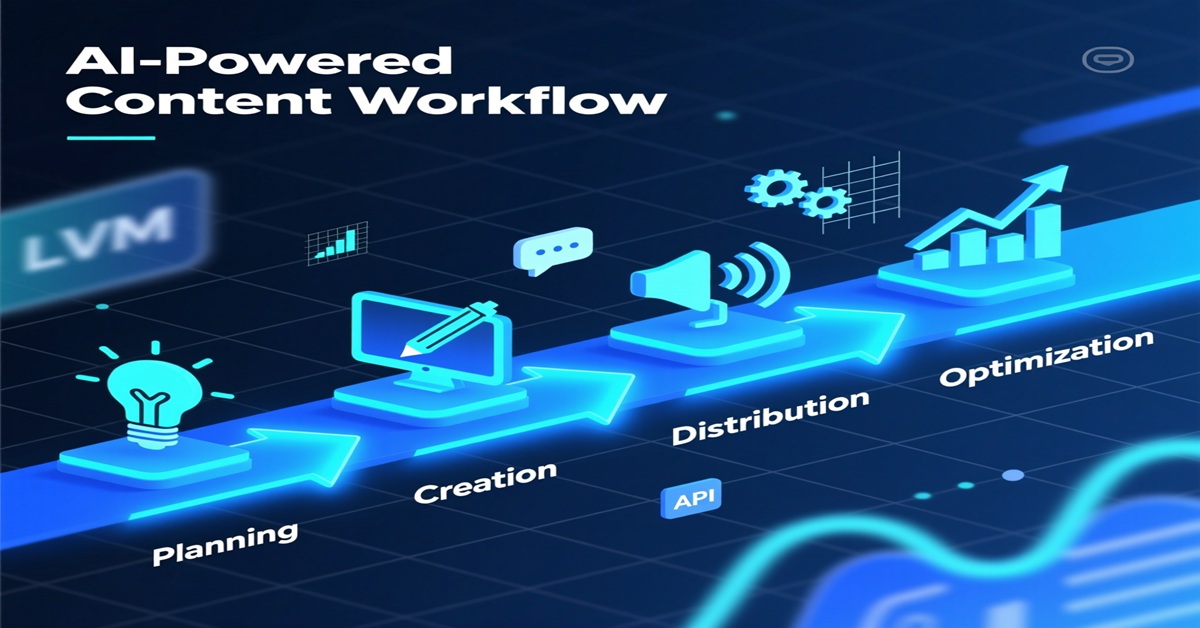
At its best, a workflow should look like a well-oiled machine: strategy feeds creation, creation feeds distribution, and distribution feeds analytics, looping back into strategy.
But here’s the harsh truth — most teams are running this machine with missing parts.
Manual workflows often collapse under their own weight:
This broken workflow doesn’t just cost time — it kills creativity. When marketers are drowning in admin work, there’s no bandwidth left for strategy or innovation.
Enter AI agents.
These aren’t your average chatbots or content generators. AI agents can observe your workflow, learn your patterns, and automate tasks end-to-end.
For example:
According to Salesforce’s State of Marketing Report, teams using AI automation see a 32% increase in campaign efficiency and 26% faster content turnaround times (Salesforce, 2025).
In short: traditional workflows manage content; AI-powered workflows orchestrate it.
Think of an AI-powered content marketing workflow as a symphony — each stage has a role, and the AI agents are your digital orchestra. They don’t replace the musicians (your marketing team); they just make sure everyone stays in rhythm, on time, and in tune with the audience.
Here’s how each layer of the workflow looks when infused with AI intelligence:
Stage 1: Planning and Research
This is where strategy lives. Traditionally, planning involves keyword research, audience analysis, and content calendar setup — all painfully manual.
AI flips that script.
According to Semrush’s 2025 Content Marketing Report, AI-driven keyword research reduces ideation time by 40% and improves ranking efficiency by 27%.
Stage 2: Creation and Optimization
Once the plan is in place, the heavy lifting begins — writing, designing, and editing.
Here’s where AI writing agents like Jasper, Copy.ai, and ChatGPT Advanced Writer Mode shine. These tools can:
For visuals, tools like Canva Magic Studio and Runway ML create blog banners, infographics, or video shorts directly from your post copy.
A report by HubSpot (2025) found that AI-assisted content performs 33% better in engagement metrics compared to fully manual content (HubSpot, 2025).
Stage 3: Distribution and Promotion
You’ve got content — now it’s time to get eyes on it.
AI-powered scheduling platforms like Buffer AI, Hootsuite OwlyWriter, and Later AI automate posting schedules based on when your audience is most active.
They can also auto-generate post captions, reformat blog snippets into social carousels, and A/B test copy across platforms.
Sprout Social’s 2025 Index shows that AI-driven scheduling increases post visibility by 23% and reduces campaign setup time by 47% (Sprout Social, 2025).
Stage 4: Analytics and Optimization
Here’s where the magic compounds.
AI analytics tools like Google Analytics 4’s AI Insights, HubSpot Smart Reports, and MarketMuse Optimize automatically detect content gaps, forecast topic performance, and even suggest what to publish next.
According to Gartner, marketers who use AI-based analytics are 2.3x more likely to hit their KPIs and 1.8x faster at adjusting underperforming campaigns (Gartner, 2025).
The Takeaway
Each of these stages — planning, creation, distribution, and optimization — forms a continuous cycle.
When powered by AI agents, that cycle becomes self-improving.
Instead of chasing deadlines, marketers can finally focus on strategy, storytelling, and scaling, the things machines can’t replicate (yet).
Building an AI-powered content marketing workflow isn’t about adding shiny tools; it’s about wiring your systems so content runs itself while you focus on growth.
Here’s a simple, scalable, plug-and-play structure you can build — today.
Step 1: Set the Foundation — Define Goals and Metrics
Before any AI enters the chat, define what success actually looks like.
Are you chasing traffic, engagement, or conversions?
Set 3–5 quantifiable KPIs like:
AI tools like HubSpot Smart Goals and Google Analytics 4 Predictive Metrics can help you forecast realistic targets based on historical data (HubSpot, 2025).
Step 2: Map Your Workflow Stages
Break your process into four key zones — Planning, Creation, Distribution, and Optimization.
Then assign AI agents or tools to each zone.
|
Stage |
Primary Tools |
What They Automate |
|
Planning |
Notion AI, SEMrush, Perplexity |
Topic ideas, keyword mapping, competitor scanning |
|
Creation |
ChatGPT, Jasper, Canva Magic Studio |
Blog writing, tone matching, image generation |
|
Distribution |
Hootsuite AI, Buffer, Metricool |
Smart scheduling, social captions, repurposing |
|
Optimization |
MarketMuse, GA4, Surfer SEO |
Content gap analysis, performance tracking, link optimization |
A Forrester 2025 Report found that teams who mapped AI across workflow zones improved cross-functional productivity by 38% (Forrester, 2025).
Step 3: Automate Repetitive Actions
This is where real ROI starts kicking in.
Use Zapier or Make (Integromat) to connect apps like this:
When a blog draft is approved in Notion → auto-publish to WordPress → share to LinkedIn + schedule tweets → log results in Google Sheets.
You can even have AI writing assistants auto-generate follow-up posts or snippets once the first piece goes live.
According to McKinsey, automating repetitive marketing tasks can reduce operational time by up to 45% and increase campaign velocity by 30% (McKinsey, 2025).
Step 4: Centralize Content Management
Use a central AI-integrated hub like ClickUp, Notion, or Airtable with automation plugins.
Here, every stage — from ideation to analytics — is visible on one dashboard.
This eliminates “lost in email thread” syndrome and makes it easier for both humans and AIs to collaborate.
A unified workspace can reduce content delivery lag by 50%, according to Asana’s 2025 Work Management Report (Asana, 2025).
Step 5: Train Your AI Agents (and Team)
AI tools learn from your inputs — tone, structure, formatting, brand voice.
Build custom AI templates or personas (e.g., “SEO Editor,” “Social Caption Writer”) using ChatGPT’s custom instructions or Jasper’s Brand Voice settings.
Run monthly reviews to train both your AI models and your human team on what’s working.
Marketers who continually “train” their AI tools report 2x faster improvement in content performance (Content Marketing Institute, 2025).
Step 6: Analyze, Adapt, and Repeat
Use AI analytics dashboards to track what’s working — and double down on it.
Connect GA4, HubSpot, and Notion or Airtable to visualize metrics in real-time.
The key? Feedback loops.
Feed your analytics data back into your planning agent so your next cycle starts smarter.
As Gartner puts it, “AI-driven marketing organizations evolve faster than static teams because data doesn’t just inform decisions — it automates them” (Gartner, 2025).
The Bottom Line
An AI-powered workflow doesn’t mean less human creativity — it means more of it, because you’re finally free from grunt work.
Build it once. Train it often. Let it run — while you scale.
| Workflow Stage | Tool | Why it matters + Best Use Case |
|---|---|---|
|
Planning |
Notion AI |
Great for ideation, organising topics, collab. Easily embed in your project hub.
|
|
Research |
Surfer SEO |
Helps optimise content for search while you plan. Useful for low-KD long-tail paths. |
|
Creation |
Jasper AI |
Knock out first-drafts, brand voice baked in. Faster content production. |
|
Drafting |
WriteSonic |
Good alternative for blog posts + SEO content generation. |
|
Distribution / Social |
Buffer (with AI features) StoryChief |
Multi-channel distribution: blog → social → email from one place. |
|
Optimization/ Analytics |
MarketMuse Google Analytics 4 + AI insights |
Deep content planning, competitive research, gap-analysis.
Track content actions + feed performance back into workflow. (Sprinklr) |
(Always check current pricing—these are ballpark numbers.)
These tools are your operational amplifiers. They don’t guarantee magic overnight—but if you use them smartly, integrate them into your workflow, you’ll scale content without sacrificing quality.
AI agents are the new employees who never sleep, never complain, and occasionally hallucinate.
They can supercharge your workflow — but only if you know where their limits end and your strategy begins.
Let’s lay it out.
AI agents automate repetitive grunt work — keyword clustering, SEO optimization, scheduling, analytics — freeing humans for creativity and strategy.
According to Accenture, AI automation in marketing can increase productivity by 40% and reduce time-to-market by 30% (Accenture, 2025).
Translation: You can do more with less — and faster than your competitors.
AI doesn’t guess; it analyzes.
It pulls insights from traffic trends, engagement metrics, and search patterns to guide what content to produce next.
Gartner found that AI-powered decision-making increases campaign ROI by 25–35% (Gartner, 2025).
You stop guessing what works — and start scaling what does.
AI agents can tailor headlines, CTAs, and even tone based on user behavior.
Salesforce’s 2025 State of Marketing Report shows brands using AI personalization achieve 1.9x higher engagement than static campaigns (Salesforce, 2025).
That’s not just more clicks — it’s deeper audience resonance.
AI doesn’t need coffee breaks. It can monitor performance 24/7 and automatically tweak posts, ad copy, or even publishing schedules.
Tools like MarketMuse and HubSpot AI now use predictive models to suggest improvements before engagement drops.
It’s like having an on-demand strategist living in your analytics dashboard.
Too much AI can make your content sound robotic or repetitive.
Readers notice when every blog feels templated.
Content Science Review warns that 60% of consumers disengage if content feels impersonal or over-automated (Content Science, 2025).
AI can write, but humans connect. Don’t lose that edge.
AI is only as good as the data it’s trained on.
If your analytics or inputs are outdated, your content strategy will reflect that.
According to Harvard Business Review, 47% of AI initiatives fail due to poor data hygiene (HBR, 2025).
Garbage in, garbage out — just faster and more confidently wrong.
Google’s algorithms are increasingly good at detecting thin, AI-spun content.
Poorly edited automation can tank rankings or trigger manual reviews.
Even Google’s Search Quality Guidelines (2025) emphasize “helpful, original, human-first content” over AI mass production (Google, 2025).
AI should assist, not replace, your editorial judgment.
AI can remix, but not originate.
It can’t pull from lived experience or gut instinct — the stuff that turns copy into storytelling.
That’s where marketers still win.
AI’s got data; humans have soul. Use both.
🧭 The Sweet Spot: Human + AI Synergy
The real power lies in collaboration:
When used wisely, AI agents don’t steal creativity — they give it space to breathe.
Meet BrightWave Marketing, a mid-sized agency with 25 employees and a full suite of B2B clients. In 2024, they were struggling to keep up with client demands: blog posts, social media content, email newsletters — the workload was overwhelming.
They decided to build an AI-powered content workflow, and within six months, results spoke for themselves.
Step 1: Audit & Identify Bottlenecks
BrightWave mapped their existing workflow and identified the pain points:
Analytics were fragmented across tools, making performance tracking cumbersome.
Step 2: Deploy AI Agents Across Workflow
|
Stage |
AI Tool |
Role |
|
Planning/Research |
Notion AI + SEMrush AI |
Automated topic ideation, keyword research, and competitor analysis |
|
Creation |
Jasper AI + Canva Magic Studio |
Drafted blog posts, social visuals, and social captions |
|
Distribution |
Buffer AI |
Scheduled posts on LinkedIn, Twitter, and Instagram; optimized timing based on engagement patterns |
|
Optimization |
GA4 + MarketMuse |
Tracked performance, suggested SEO improvements, and identified content gaps |
“We didn’t just want tools — we wanted agents that could think along with us,” says BrightWave’s Content Director.
Step 3: Integrate Humans + AI
BrightWave implemented a review layer: human editors focused on voice, storytelling, and client-specific tweaks. AI handled the heavy lifting — drafts, image creation, analytics.
This approach preserved brand personality while maximizing efficiency.
Step 4: Measure & Iterate
Within six months:
Key Takeaways
The Bottom Line
BrightWave’s story proves a simple truth: AI agents don’t replace teams — they amplify them.
With the right setup, even mid-sized agencies can scale content production, improve performance, and reclaim hours for strategy and creative thinking.
AI agents are no longer futuristic toys — they’re here, transforming how content marketing is done.
The key takeaway? Success isn’t about replacing humans with AI; it’s about amplifying human creativity with AI efficiency.
By strategically integrating AI into planning, creation, distribution, and optimization, marketers can:
An AI-powered content marketing workflow uses artificial intelligence tools or “AI agents” to automate repetitive parts of the content creation process — from topic research and writing drafts to social media scheduling and analytics. This lets marketers focus on strategy, creativity, and storytelling while AI handles execution and optimization.
AI improves efficiency by automating time-consuming tasks like keyword research, blog outlining, A/B testing, and content repurposing. Marketers report saving up to 30–50% of their time using AI tools such as Jasper, Notion AI, and ChatGPT for planning and drafting.
AI agents are intelligent systems trained to perform specific marketing tasks — like generating copy, analyzing SEO data, or creating social media posts. They can operate autonomously, take commands, and even learn from your data to continuously improve output quality.
Start by mapping your current content process, identifying repetitive or data-heavy steps, and assigning AI tools to handle them. For example:
Use ChatGPT or Jasper for writing
SurferSEO for optimization
Canva AI for visuals
Zapier for automation between platforms
Then, test and refine your workflow every month.
No — AI can’t replicate creativity, emotional intelligence, or brand storytelling. The best results come from AI-assisted marketing, where humans provide the creative direction and AI handles production and optimization. Think of AI as a powerful intern, not a replacement.
Some of the top-performing tools right now include:
ChatGPT / Jasper – Content generation
SurferSEO / Clearscope – SEO optimization
MarketMuse – Content strategy insights
Notion AI / ClickUp AI – Workflow automation
Buffer AI / Hootsuite AI – Social content scheduling
GrammarlyGO – Tone and grammar editing
Use metrics tied to your content goals — such as organic traffic growth, content production time, engagement rate, and ROI per piece. If you’re saving hours and publishing more consistently with better performance metrics, your AI workflow is doing its job.
Not if it’s used correctly. Google rewards helpful, high-quality content — whether written by humans or AI. The key is ensuring human review, brand consistency, and genuine value for readers. AI should enhance your process, not churn out spammy articles.
AI-driven workflows are especially effective for:
Ecommerce brands (product descriptions, SEO blogs)
Agencies (scalable workflows for multiple clients)
Real estate (local SEO and ad copy)
Education and SaaS (tutorials, explainer content)
Basically, any industry that needs consistent, optimized content at scale can benefit.
The next era is AI-first marketing, where teams are built around AI tools from the start. Expect personalized content, predictive analytics, and fully automated feedback loops that learn and improve over time — making marketing more efficient and data-driven than ever.

This article is written by Asar, a digital marketer and Project Manager helping businesses future-proof their online visibility through AI-driven SEO strategies.
With a background in Marketing Analytics and hands-on experience on building SaaS and eCommerce products, Asar combines real-world data, case studies, and actionable tactics to stay ahead of the curve.
 in India
 To provide the best experiences, we use technologies like cookies to store and/or access device information. Consenting to these technologies will allow us to process data such as browsing behavior or unique IDs on this site. Not consenting or withdrawing consent, may adversely affect certain features and functions.
Manage your cookie preferences below:
Essential cookies enable basic functions and are necessary for the proper function of the website.
You can find more information in our Cookie Policy (EU) and Privacy Policy.

really enjoyed reading this today u made some very valid points that i am gonna think about. i have been thinking about this specific issue a lot lately and your post helped me clarify my own thoughts on it. it is always good to get a fresh take from someone who actually knows what they are talking about. thanks for the great read and for the insights!